Tuesday, October 19, 2010

2011 Nissan Versa Hatchback SL

The Nissan Versa was introduced in 2006 as a 2007 model as Nissan’s entry level vehicle. The Versa comes as a 5-door hatchback or sedan and believe it or not, there is a method to the madness with the name Versa. It’s an amalgam of Versatile and Space….okay, I’ll buy it but none the less, the Versa is indeed roomy for such a small car although it is a bit tight behind the wheel for an “athletic build” like mine.

The 2010 Versa received a fair amount of upgrades so the 2011 model only offers a few minor changes. ABS is standard on the 1.8 S, Traction control and Nissan’s Vehicle Dynamic Control are standard on 1.8 SL models, and optional on 1.8 S models. However, they remain unavailable in both 1.6 models.

The 1.6 liter in the base sedan puts out 107 horsepower and the 1.8 liter in the S and SL puts out 122 horsepower which allows for mileage ratings between 25 and 34mpg. And of course economy and utilitarianism is what the Versa is all about. One very surprising factor for me is the plethora of transmissions.

There’s an optional 4-speed automatic available for the base and 1.8S models, however its standard on the 1.8SL and not available for the others. There’s a 5-speed manual overdrive available for the 1.6 Sedan and Base Sedan but not for anything else. Then there’s the 6-speed manual overdrive that’s standard only on the 1.8S and not available on any others and finally there’s the CVT, Continuously Variable Transmission that’s standard only on the 1.8SL Hatchback and on nothing else.

Inside is spartan and functional albeit a bit cramped for me, but there is plenty of room for four. Power windows and locks, remote keyless entry, and cruise control are standard on the 1.8 SL model, optional on the 1.8 S, and unavailable on the 1.6 models. The 1.8 SL also has an exclusive power moon roof option. The 1.8 SL model also includes a 5-inch touch-screen and subscription-based XM Satellite Radio as well as Bluetooth connectivity and volume controls on the steering wheel.

On the road you pretty much get what you’d expect from a vehicle like the Versa. It’s solid and although it actually rides a bit better than I’d expected, in my opinion it’s still strictly a grocery getter and not something I’d look forward to driving for any length of time.

Nissan has a history of building pretty solid, safe and reliable cars and the Versa fits right in. So if you’re looking for a decent run around car that’s decent on gas and dependable, keep the Versa on your short list. Backed by Nissan’s standard 36-month, 36,000-mile limited warranty, with price ranges from $9,900 to $17,650, the Nissan Versa could be just the value you’re looking for.

Monday, October 18, 2010

2010 Mazda Miata MX-5

It’s still the one to beat

For anyone that’s followed my reviews over the years knows that I have a special affinity for the Miata, the or MX-5 as Mazda likes to call it now. We’ve owned a few in our time and in truth the only reason we don’t have one now is due to the fact that the power hard top wasn’t available until 2007 and that change alone opened the floodgates to allow the best selling sports car in history to tap an even bigger market.

Introduced in 1989 the MX-5 remains basically unchanged after receiving significant updates for 2009 when Mazda added RX-8 style bold fender flares, a large grille, bigger wheels and tires and dual chrome exhaust pipes. The design changes did give the MX-5 a bit more aggressive look that will hopefully attract more male buyers.  

I've always been a roadster fan and loved the old classics like the MGB and TR-6’s etc but if you owned one of those vehicles, as I did, you knew you were going to spend a fair amount of time “tinkering” with your car. Not so with the Miata. You got all the fun, and exuberance of the classics without any of the hassle. No leaking tops, no electrical problems, no quirky carburetors, nothing. Get in start the car and hit the highway.

The car is simply stated, an absolute blast to drive and for all it’s simplicity, it’s pretty civilized. The test car came with an inline 167 horsepower 4-cylinder paired with a 6-speed manual transmission which made for a really fun driving experience. For those that don’t want to manually shift, a 6-speed automatic with paddle shifters is available, but in truth, the only way to have this car is with the manual.

Steering is swift and sure, with great linear brake pedal action making handling very crisp, almost like that of a go-kart. And for a car with less than a 92 inch wheelbase the ride isn’t nearly as rough as one might expect. One minor annoyance is the 6-speed gearing. Fuel economy is decent at 22 and 28 but a taller sixth gear could improve on that significantly and since there’s only 140 lb-ft of torque, you have to downshift to expediently pass at 65, so I don’t understand why they didn’t make sixth a true over-drive gear.

This is a two-seater so there isn’t a lot of extra space in the cabin, and unfortunately the cupholders are positioned in such a way that a cup of coffee or soft drink can be in the way of the shifter. The very good news is that there are lots of places to store things and the trunk does have enough room for a full set of golf clubs but two sets could be difficult. Believe me though; it’s a minor problem though for the true enthusiast.

Bottom line, the MX-5 is still the king of the hill when it comes to serious two-seat fun. It’s inexpensive, prices start at just a under $23,000 for the base Sport and the top of the line Grand Touring PHRT, which is what our test car was, starts at just over $28,000, and with adds the tester came in at just under $33,000. It’s dependable and pretty economical and as I said, an unadulterated blast to drive. There are a couple of pretty nifty looking competitors out there but they don’t come close to unseating the Miata as the King of the Hill of fun roadsters.

So, if you’re looking for something that doesn’t cost a lot to buy and operate and is a boat load of fun, check out the new MX-5 by Mazda. I think you’ll like it a lot.

Friday, October 15, 2010

2011 Maxima SV Premium

4 Door Sports Car contender or pretender

The Maxima has been around since the 1981 model year and was originally a rear-wheel-drive car until the second generation when Nissan switched it to a front-wheel-drive car to the chagrin of many like me. I always found it interesting that Nissan tries to sell the Maxima as a 4-door sports car and while I don’t think it quite lives up to that label, low and behold, right there on the rear quarter glass of the my test car I saw, 4DSC. You got it, 4 door sports car. Well I kind of subscribe to the philosophy of knowing something when I see it and at first blush I have to admit the new Maxima has a pretty sporty look. More on how it drives later.

The Maxima is available as a base S model and the SV with both being powered by the 3.5 liter 290 horsepower V6 and mated to a Constantly Variable Transmission. Standard on the Maxima S are 18" aluminum-alloy wheels, power sliding moonroof, Nissan Intelligent Key® with Push Button Ignition, Bluetooth® Hands-free Phone System, and Vehicle Dynamic Control with Traction Control System.

The SV adds fog lights, outside mirrors with LED turn signal indicators, digital Bose® audio system with 9 speakers and 2 woofers, XM® Satellite Radio, leather-appointed seats, driver’s seat adjustable thigh support extension, and power lumbar support. The Sports Package adds sport-tuned suspension, 19" aluminum-alloy wheels with P245/40VR19 tires, rear spoiler, paddle shifters, High Intensity Discharge (HID) xenon headlights, dark chrome grille, smoked headlights and interior metallic-link trim.

My test car was the top of the line Premium which adds Dual Panel Moonroof with power retractable sunshades, rear-window power sunshade, premium mood lighting, 7.0" QVGA color display with RearView Camera Monitor, 2 GB Music Box® USB connectivity and eucalyptus wood-tone trim. Pricing range for the Maxima goes from 30,000 for the S, up to $36,760 for the Premium.

I took the Maxima on a quick run to California from Phoenix to catch my granddaughter’s softball tournament and I was very pleased with how comfortable the car was for 4 adults because according to my wife and daughter-in-law, the back seating area was plenty roomy for the two of them.

I’m not yet a big fan of the CVT, or constantly variable transmission and not sure I ever will be since I’m so used to playing with gears. Interestingly, the CVT has been around for over 100 years so it’s not new technology but heretofore materials weren’t durable enough for the big engines in cars. The main advantage is the simplicity of the CVT, you have a belt, some pulleys and microprocessors and that’s pretty much it. The downside is the weight. That said, I just don’t like the whining/moaning sounds that emanate from CVT’s.

Bottom line is, the new Maxima may not yet be a true 4-door sports car but it’s made huge gains in that direction. There’s a pretty stiff amount of competition when you get in the 36 to 37,000 dollar range, like the Lincoln MKZ, the Ford Taurus, the Volvo S60 and the Buick Lucerne to name a few. So do I think the Maxima lives up to the 4 Door Sports Car moniker, not quite, but if you haven’t been in one lately, put the Maxima on your list to check out. I was pleasantly surprised and I’m thinking you will be to.

2011 Lincoln MKT

Station Wagon or Crossover

Introduced in 2010, the MKT is Lincoln’s entry in the full-size luxury crossover segment offering three rows of seating and what Lincoln describes as the best possible blend of fuel economy, performance and technology. The MKT design features Lincoln’s signature split waterfall grille and I have to admit, I really don’t like the look at all. It just seems a bit overbearing to me and detracts from the overall look. That said the THX sound system is second to none.

The MKT is offered in either 6- or 7-passenger configurations, a second-row 60/40 split folding bench seat with heated outboard seating positions all standard. Optional power “fold and tumble” second-row bucket seats include heating, cooling and power lumbar adjustment and an available 5-quart refrigerator in the center console which all came in very handy for a weekend of grandkids soccer games. A fixed glass Panoramic Vista Roof with power-assisted front and rear sunshades is standard and a Power Panoramic Vista roof is optional.

What Lincoln does well with the MKT is offer a whole lot with the standard model. Some include wood inlays on the dashboard, door panels and the steering wheel. The also make the rear liftgate power and rain sensing wipers and heated rear seating. Obviously you get all the usual luxury features you’d expect from Lincoln like leather trim, power adjustable steering column, the Sync entertainment system and puddle lights.

Opt for the Premium Package and you get 12-way front power seats, rear footrests and rear-window sunshades, among other things. The Elite Package brings a voice-activated DVD navigation system with single DVD/CD/MP3 player, 10 gigabytes of music storage and SIRIUS Travel Link. The most fun part of testing the MKT was showing off Ford’s latest radar-guided blind-spot and parking lot warning aids which allows the MKT to park itself….yep, it literally parallel parks itself and quite easily at that.

The MKT is powered by and efficient albeit a bit underpowered 3.7 liter V6 that puts out 268 horsepower and 270 lb-ft of torque which unfortunately is a bit lackluster for this big a vehicle. That’s not the case with the very slick 3.5 liter dual turbocharged EcoBoost V6 engine that pumps out 355 horsepower and 350 lb-ft of torque which adds a huge fun quotient to driving the MKT. The EcoBoost engine is so efficient that despite weighing in at almost 5000 pounds, the MKT gets 16 mpg in the city and 22 mpg on the highway.

Bottom line, whether you call the Lincoln MKT a CUV or a new age station wagon isn’t important and doesn’t alter the fact that it is a very versatile vehicle. It’s a big and roomy, ergo comfortable, and with the EcoBoost engine, it’s plenty spunky. So if you’re looking for a multitasking vehicle, the Lincoln MKT may fit the bill. With base pricing starting just over $44,000 and the EcoBoost AWD iteration tickling $50,000 it isn’t cheap, but then again, it is a Lincoln.

Tuesday, October 12, 2010

TWO FOR THE ROAD TEST DRIVES HEAT

All-new Dodge Nitro model lineup gives more bang for your buck

The Dodge Nitro lineup has been revised and renamed for 2010, offering new exterior and interior styling and new standard features and safety equipment for 2010. These new models (Heat, Detonator and Shock) provide Nitro customers with more standard content, including a standard 4.0-liter V-6 engine, 20-inch aluminum wheels, eight premium speakers with a 368-watt amplifier and 9-inch subwoofer, deep-tinted glass, Uconnect Phone, iPod Control, SIRIUS Satellite Radio, auto-dimming rear-view mirror, speed control and security alarm.

In addition to the curb appeal gained from its 20-inch painted Mopar® aluminum wheels and body-color grille with bright billets, the 2010 Dodge Nitro Heat packs a punch with 23 percent more horsepower and 12 percent more torque than the previous entry-level model. With its aluminum 4.0-liter overhead cam V-6 engine, the Nitro Heat, and the entire Nitro lineup, delivers 260 horsepower (194 kW) and 265 lb.-ft. (359 N•m) of torque with a five-speed automatic transmission. MSRP for the 2010 Dodge Nitro Heat is $23,995 (including $745 destination).

The Dodge Nitro Detonator offers new exterior design cues, as well as standard interior and safety features that were previously optional on the former SXT model. The new Dodge Detonator model features 20-inch Mopar polished/painted aluminum wheels, hood decal, eight speakers plus subwoofer, remote start, ParkSense® rear-park assist and color-keyed premium cloth interior that matches the exterior paint color. MSRP for the 2010 Dodge Nitro Detonator is $25,995 (including $745 destination).

The Dodge Nitro Shock adds heated leather seats and a sun roof to the Nitro Detonator model. MSRP for the 2010 Dodge Nitro Shock is $26,995 (including $745 destination).
The new 2010 Dodge Nitro

Saturday, October 2, 2010

2010 Volkswagen CC Sport

The CC is Volkswagen’s new four-door coupe that was introduced in 2009 and Volkswagen describes as combining sports car dynamics and dimensions with sedan comfort. It features a long hood, strong shoulder line, rear-swept roofline and short trunk lid, the athletic but elegant look is accentuated by large wheels and tires, deep front air dam and bold grille. And yes, it has pretty much the same profile as the Mercedes CLS.

As far as the styling goes, there’s no question that the CC is a very sleek looking sedan and I got comments a plenty about my Shadow Blue Metallic test car confirming that. The car looks great from any angle with styling reminding me in its own way of the “sleek smooth and sassy” slogan of the ’57 Chevy. The sloping roofline finishes of in a short deck with just a trace of a spoiler. The front end is elegant with sculpted headlamps that sweep smoothly back into the front fenders giving the car a very elegant look.

Inside is no less stellar with the instrument panel smooth and uncluttered with a no-nonsense yet sophisticated cockpit. The center stack houses the information center and the ergonomics are well thought out and relatively easy to use. The seats are sporty yet stylish and offer good support up front and the rear seating area is decent with the caveat that tall rear seat passengers will feel the squeeze from the sloping roofline, but all in all it’s very nice inside.

Driving the CC is what I’d describe as a pleasant experience; nothing very scintillating about it but nothing unpleasant. That may be a different story with the VR6 Sport or 4Motion iteration but the rather lackluster performance of the 2.0 turbocharged test car was rather boring. That said I’m not sure the 10 to 12 thousand dollar price differential is something I’d be willing to pay because of the competition that comes in to play in the mid-thirty to forty thousand dollar range. When you start pulling the BMW 3 Series, the Lexus IS and Infiniti G into the mix you have some pretty strong proven competition and it’s unfortunate that Volkswagen didn’t put some of the vaunted German engineering into the CC to give it just a bit more of a performance edge.

All in all by bringing sleek luxurious styling to bear, I think Volkswagen is on the right track with the CC however in many ways it reminds me of the somewhat infamous VW Phaeton. A well built decent performing comfortable vehicle but seemingly trying to morph into a luxury car that it just doesn’t have the heritage necessary to convince anyone to buy other than a brand loyal buyer.

I could be wrong and if the Volkswagen CC Sport is snazzy enough and is the size vehicle you’re looking for in a price range that works for you, I’d certainly recommend driving one. You may just find it’s exactly what you’re looking for.

Friday, October 1, 2010

2011 Kia Sorento

Back and better than ever

After taking a brief hiatus, The Sorrento is back and the time off did it some good.
The Sorento is Kia’s midsize SUV and it’s virtually all-new for 2011 after taking the 2010 model year off. The new Sorento comes with a unibody platform that offers more interior space, with room for up to seven occupants, while delivering a much improved ride. The new exterior design incorporates some familiar design cues like the grille and wraparound headlights that you’ll see on the Forte. It’s also lighter which translates into more agility and better fuel economy as well.

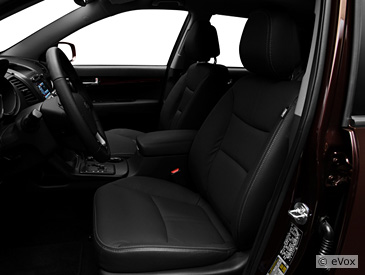
While there was plenty of space in the front seats on the previous Sorrento, the back was particularly cramped for just about anyone over 10 years old. On top of that they were uncomfortable and not very supportive. That’s hardly the case on the 2011 iteration as Kia has taken care of those issues. The new Sorrento offers seats that are literally luxurious compared to the previous model, offering good support and a much more comfortable ride. In the back, seats offer more room for passengers and behind the second row you’ll find plenty of space for luggage or other cargo. Though the third-row seat is a nice option, in truth it really only works with kids or very small adults.

The new Sorrento now offers and efficient 2.4 liter 172 horsepower, 166 lb-ft of torque 4-cylinder engine mated to a 6-speed automatic transmission as standard equipment. For those that want a bit more punch, step up to the 3.5 liter V6 that pumps out 273 horsepower and 247 lb-ft of torque paired with the same 6-speed automatic tranny. All-wheel-drive is available on all but the base Sorrento.
 
The V6 is certainly powerful and quick but the 4-cylinder offers plenty of performance for pretty much all but the most demanding performance driver. That’s because the new Sorrento has shed some 400 pounds which of course affects performance, fuel economy and handling, which is much more agile than the predecessor. The mpg numbers for the 2.4-liter are 21/29 with the V6 numbers coming in at 19/26 in 2WD with just about a 1mpg loss in the AWD drive train.  

I’m very impressed with the direction Kia is going with styling and quality throughout the line up albeit at a cost. Although the base Sorrento still starts under $20,000 if you’re not careful you can add a lot of goodies that can run the price into the mid $30,000 range in a hurry. The new Sorrento is in some pretty hefty competition with the likes of the Chevy Equinox, Nissan’s Murano just to name a couple. Kia’s edge is the 100,000 mile warranty so it will be interesting to see how the Sorrento does. My guess is it’ll do just fine. So if you’re looking for an SUV that's roomy, efficient with enough punch to get the job done, and a great warranty to boot, you need to check out the all-new 2011 Kia Sorento. It may be just what you’re looking for.